
















Reading time: 5 minutes
When you're exhausted, you take a break. That sounds logical, but it often falls short. Many people lie on the sofa in the evening, scroll through their phones, or sleep their eight hours, yet still don't feel rested the next morning. The reason isn't a lack of willingness to rest, but a misunderstanding of what stress reduction actually means.
Regeneration is not a state that occurs by itself as soon as you stop being active. It is a process that the nervous system must actively control, and this process can be specifically supported.
Content
Why taking a break isn't the same as recovering
Objective rest and actual recovery are two different things. This is particularly evident in people who are under severe professional stress: Vrijkotte and colleagues examined over a hundred employees using ambulatory monitoring and found that with a high discrepancy between effort and recognition, heart rate remained elevated even after work, and vagal tone, i.e., the activity of the calming part of the nervous system, was lower throughout the entire day than in less stressed colleagues.¹ The body remains in "on-duty" mode, even when the actual stress has long passed.
One reason for this lies in the mind: worries and rumination prolong the stress-related activation of the body beyond the actual event, sometimes into the night.² So, you don't have to be stressed anymore to still react as if you are stressed. This explains why mere inactivity is often not enough.
What really happens in the nervous system
The human body has two operating modes: the sympathetic nervous system, which activates, and the parasympathetic nervous system, which regulates and recovers. In our last article, we already described how chronic stress makes this switch difficult and why pure willpower is of little help.
Scientifically, this can be classified using the concept of so-called allostatic load: The body reacts to stress with a whole cascade of adaptation reactions, mainly via the sympathetic nervous system and stress hormone systems. If this reaction does not reliably shut down, the load accumulates over time.³ How well this shutdown succeeds is measurable: people with lower vagal activity at rest showed significantly poorer recovery of heart rate, blood pressure, cortisol, and inflammatory markers after stress exposure in an experiment than people with higher vagal activity.⁴ The parasympathetic nervous system is therefore not an abstract quantity, but a trainable factor for one's own ability to recover.
The underestimated lever: conscious breathing
If the parasympathetic nervous system is trainable, the question arises as to the most effective lever. The most extensive data to date on this comes from Laborde and colleagues: In their meta-analysis of 223 studies, slow, conscious breathing reliably increased vagally mediated heart rate variability, both during the breathing exercise itself, immediately afterward, and also with repeated application over a longer period.⁵ Further review articles confirm this connection between controlled, slow breathing and a shift in the sympathovagal balance, i.e., the ratio between the sympathetic and parasympathetic nervous systems, in favor of the parasympathetic nervous system.⁶ ⁷
 Indispensable for restorative regeneration: Proper breathing.
This is the crucial difference to mere resting: breathing is a direct, measurable access to the autonomic nervous system. Those who consciously breathe slower and deeper do not activate some vague idea of relaxation, but a concrete physiological mechanism that is reproducibly shown in studies. This is precisely why breathing training is the most effective way to make stress reduction measurable, instead of just claiming it.
Blood circulation as the second level of regeneration
In addition to the nervous system, vascular function also plays a role in regeneration. The effect of L-arginine can be clearly explained: the amino acid is the precursor for the body's own production of nitric oxide, a messenger substance that dilates blood vessels. Lerman and colleagues showed in a six-month placebo-controlled study in patients with pre-existing coronary disease that regular L-arginine intake significantly improved the response of the coronary arteries to a vasodilating stimulus compared to placebo.⁸ Important for an honest assessment: A meta-analysis of several controlled studies shows that this effect is primarily measurable when vascular function was previously impaired. If the initial function is already good, the additional benefit is small.⁹ Whether L-arginine can improve regeneration therefore strongly depends on the initial state of the vessels. L-arginine is thus a supportive, but not a universal, mechanism.
L-lysine is also frequently mentioned in the same context. Here, caution is advised: L-lysine is an essential building block for the cross-linking of collagen and is therefore involved in the structure of connective tissue.¹⁰ However, there is no direct evidence to date that L-lysine intake in humans improves blood circulation or regeneration. This statement remains deliberately open at this point, rather than over-interpreting it.
Making regeneration a routine
These findings lead to a clear sequence for practical application. The most effective first step is a daily, short breathing exercise, ideally with a noticeably slowed breathing rhythm, for example with a breathing belt for direct feedback on one's own breathing. This step is best supported by scientific evidence and can be integrated into daily life in just a few minutes.
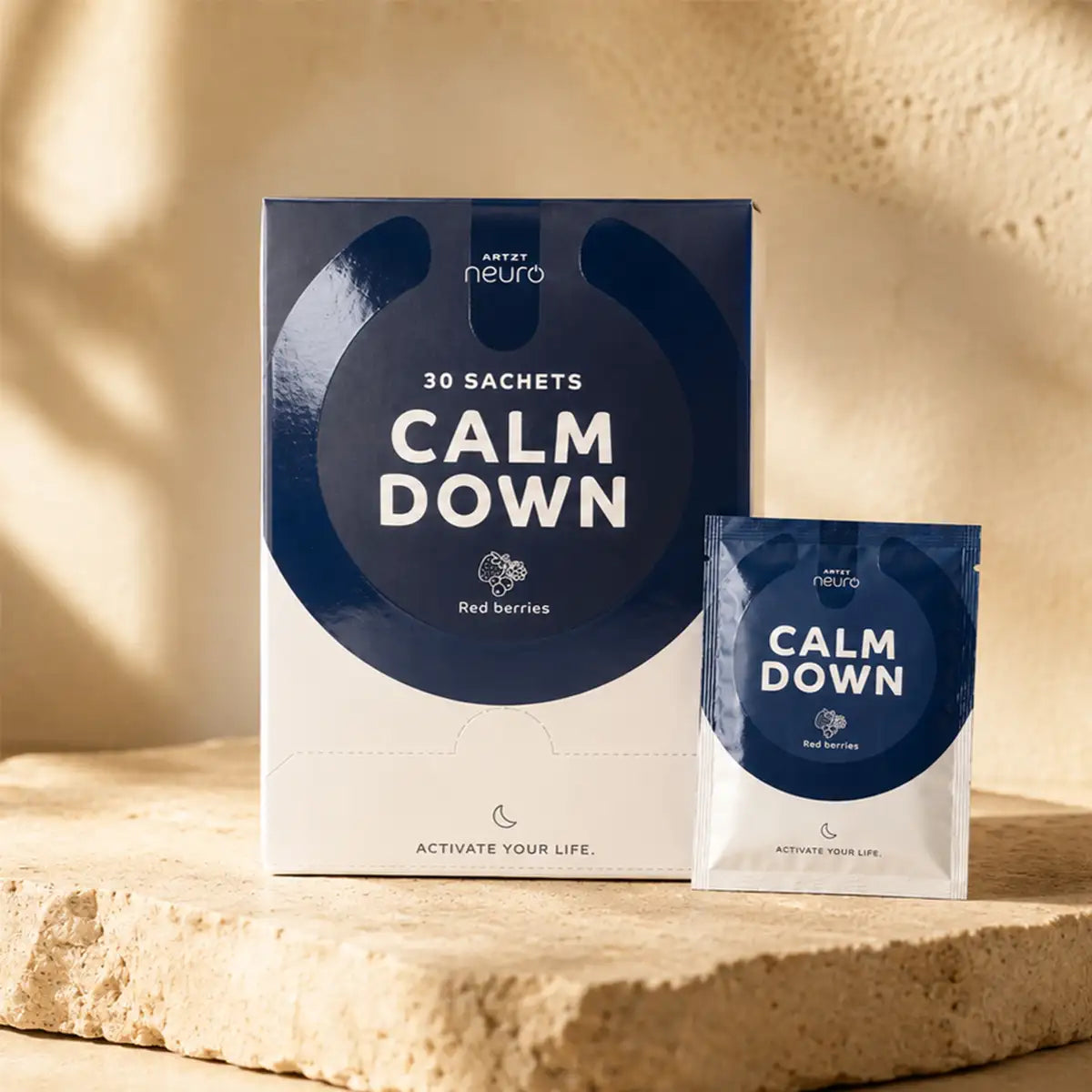
To ensure that this routine doesn't falter even on stressful days, a system is needed to keep the foundation stable. This is exactly where Calm Down comes in: Magnesium contributes to the normal functioning of the nervous system, and folate contributes to normal psychological function. The amino acid L-theanine, also included, is frequently mentioned in this context, its effect on relaxation is the subject of ongoing research, but so far without an approved health claim, which is why we deliberately do not formulate it as a promise of effect here. Calm Down does not replace active breathing work, but supports the physiological basis on which this work can even take effect, especially when everyday life and stress put one's discipline to the test. In combination with the Recovery Tape for nocturnal recovery, a system is created that does not leave regeneration to chance.


Conclusion
Regeneration is not a passive state, but an actively controllable process of the nervous system. Those who merely pause without specifically activating the parasympathetic nervous system remain in a recovery deficit, even after sufficient sleep or a quiet weekend. Conscious breathing is the best-proven and most direct lever. This aligns with a fundamental idea we already described in our article on holistic health: sustainable improvement rarely results from a single measure, but from the interplay of multiple systems.
Supportive systems like Calm Down help to reliably use the breathing lever even when everyday life makes it difficult. Stress reduction thus begins not with the next free minute, but with the decision to actively train one's own nervous system.
References
- Vrijkotte, T. G. M., van Doornen, L. J. P., & de Geus, E. J. C. (2000). Effects of work stress on ambulatory blood pressure, heart rate, and heart rate variability. Hypertension, 35(4), 880–886. URL: https://pubmed.ncbi.nlm.nih.gov/10775555/
- Brosschot, J. F., Gerin, W., & Thayer, J. F. (2006). The perseverative cognition hypothesis: a review of worry, prolonged stress-related physiological activation, and health. Journal of Psychosomatic Research, 60(2), 113–124. URL: https://pubmed.ncbi.nlm.nih.gov/16439263/
- McEwen, B. S. (1998). Protective and damaging effects of stress mediators. New England Journal of Medicine, 338(3), 171–179. DOI: 10.1056/NEJM199801153380307 | URL: https://pubmed.ncbi.nlm.nih.gov/9428819/
- Weber, C. S., Thayer, J. F., Rudat, M. et al. (2010). Low vagal tone is associated with impaired post stress recovery of cardiovascular, endocrine, and immune markers. European Journal of Applied Physiology, 109(2), 201–211. DOI: 10.1007/s00421-009-1341-x | URL: https://pubmed.ncbi.nlm.nih.gov/20052593/
- Laborde, S., Allen, M. S., Borges, U. et al. (2022). Effects of voluntary slow breathing on heart rate and heart rate variability: A systematic review and a meta-analysis. Neuroscience & Biobehavioral Reviews, 138, 104711. DOI: 10.1016/j.neubiorev.2022.104711 | URL: https://pubmed.ncbi.nlm.nih.gov/35623448/
- Zaccaro, A., Piarulli, A., Laurino, M. et al. (2018). How Breath-Control Can Change Your Life: A Systematic Review on Psycho-Physiological Correlates of Slow Breathing. Frontiers in Human Neuroscience, 12, 353. DOI: 10.3389/fnhum.2018.00353 | Freely accessible full text: https://www.ncbi.nlm.nih.gov/pmc/articles/PMC6137615/
- Russo, M. A., Santarelli, D. M., & O'Rourke, D. (2017). The physiological effects of slow breathing in the healthy human. Breathe, 13(4), 298–309. DOI: 10.1183/20734735.009817 | Freely accessible full text: https://pmc.ncbi.nlm.nih.gov/articles/PMC5709795/
- Lerman, A., Burnett, J. C., Higano, S. T. et al. (1998). Long-term L-arginine supplementation improves small-vessel coronary endothelial function in humans. Circulation, 97(21), 2123–2128. DOI: 10.1161/01.cir.97.21.2123 | URL: https://pubmed.ncbi.nlm.nih.gov/9626172/
- Bai, Y., Sun, L., Yang, T., Sun, K., Chen, J., & Hui, R. (2009). Increase in fasting vascular endothelial function after short-term oral L-arginine is effective when baseline flow-mediated dilation is low: a meta-analysis of randomized controlled trials. American Journal of Clinical Nutrition, 89(1), 77–84. DOI: 10.3945/ajcn.2008.26544 | PMID: 19056561 | URL: https://pubmed.ncbi.nlm.nih.gov/19056561/
- Salo, A. M., & Myllyharju, J. (2021). Prolyl and lysyl hydroxylases in collagen synthesis. Experimental Dermatology, 30(1), 38–49. DOI: 10.1111/exd.14197 | URL: https://pubmed.ncbi.nlm.nih.gov/32969070/
Transparency note: This article was created by our editor Jonas with the help of AI and subsequently edited.