

















Reading time: 10 minutes
You go out regularly, eat consciously, and have your supplement shelf well under control. Yet, you feel noticeably more exhausted in winter, and your energy levels fluctuate more than you can explain? The cause often isn't a lack of discipline, but a nutrient that is chronically underestimated in Germany: Vitamin D. And a second one that is rarely considered, although it co-determines the effect of the first: Vitamin K2.
Contents
- Vitamin D Deficiency in Germany: How Widespread Is It Really?
- Why the Sun Alone Isn't Enough: Synthesis and Latitude
- Recognizing Vitamin D Deficiency: Symptoms and Vitamin D Levels
- K2 as a Vitamin D Partner: Why Calcium Needs a "Conductor"
- Properly Taking Vitamin D and K2: Dosage, Timing, Safety
- Vitamin D Throughout the Year: Winter and the Immune System
- Conclusion: Sunshine Vitamin Plus K2 as Basic Supply
- Briefly Explained: The Most Important Questions About Vitamin D and K2
Vitamin D Deficiency in Germany: How Widespread Is It Really?
Vitamin D deficiency is often treated as a fringe issue in Germany, but the data paints a different picture. From the DEGS1 study by the Robert Koch Institute, we know that 61.6 percent of adults in Germany have a 25(OH)D value below 50 nmol/l and are thus considered to have insufficient supply. For 30.2 percent, the value is even below 30 nmol/l, the threshold for a manifest deficiency.¹ In the winter half-year, when the body's own production practically ceases, this picture becomes even more pronounced.
This explains why vitamin D deficiency rarely manifests through a single, clear symptom, but rather as a diffuse background noise. Those who feel persistently more exhausted in winter than in summer are statistically more the rule than the exception.
According to the German Nutrition Society, some groups have an additionally increased risk: older people, because vitamin D production in the skin significantly decreases with age; people who spend little time outdoors, for example due to predominantly sedentary office work; and people who fully cover their skin when outdoors for cultural, religious, or health reasons.³ Anyone who finds themselves in one of these groups should monitor their own supply not only in winter but for large parts of the year.
Why the Sun Alone Isn't Enough: Synthesis and Latitude
The name "sunshine vitamin" is biologically correct yet misleading. Under typical living conditions in Germany, the body's own production in the skin covers 80 to 90 percent of the vitamin D requirement, according to the German Nutrition Society, while diet provides only 10 to 20 percent.³ The Federal Institute for Risk Assessment therefore recommends exposing about a quarter of the body surface—face, hands, and parts of arms and legs—to direct sunlight several times a week for 5 to 25 minutes, depending on skin type, for about half of the year.⁴
This is precisely where the problem lies: this half of the year is not evenly distributed at German latitudes. The actual production process occurs exclusively via UVB radiation: it converts a precursor of cholesterol in the skin into vitamin D3 through several intermediate steps, a purely photochemical process that simply does not start without sufficient high-energy UVB light. A classic study by Webb, Kline, and Holick from 1988 shows that between autumn and spring, at latitudes of about 42 degrees North and above, UVB radiation is no longer sufficient to initiate this process in the skin, regardless of how long one stays outdoors.²
The underlying mechanism, the sun's position (zenith angle), determines how much UVB radiation actually reaches the Earth and is physical in nature and has not changed since. A study published in 2021, in which Holick was again involved, confirms this correlation with current measurement data and shows that vitamin D3 production in the skin still directly depends on the solar zenith angle today.¹¹
Germany is located between 47 and 55 degrees North. From October to March, the body's own synthesis in this country is therefore not just limited, but simply impossible. Those who rely solely on "going out more" during this time are working against their own biology, not their own discipline.
Even people who work outdoors often have a vitamin D deficiency.
Recognizing Vitamin D Deficiency: Symptoms and Vitamin D Levels
The symptoms of vitamin D deficiency are non-specific, which makes self-assessment difficult. Persistent fatigue, noticeably reduced resilience, muscle weakness, and increased susceptibility to infections are among the most frequently described signs. These complaints do not replace a diagnosis; they could just as well have other causes.
Reliably assessing vitamin D levels is only possible through a blood test for the 25(OH)D value. Values below 30 nmol/l are considered deficient, values between 30 and 50 nmol/l are considered insufficient, and values above 50 nmol/l are considered sufficient.¹ If you observe typical symptoms, you should not guess your own level, but have it tested before supplementation can be sensibly dosed.
A single measurement is a snapshot, not a permanent diagnosis. Since endogenous synthesis fluctuates greatly throughout the year, the same value can be classified completely differently in late summer and late winter. Therefore, those who supplement regularly benefit from a check at two points in the year, for example at the end of summer and the end of winter, instead of relying on a single measurement.
K2 as a Vitamin D Partner: Why Calcium Needs a "Conductor"
However, vitamin D only tells half the story. One of vitamin D's central functions is to increase calcium absorption from food. Where this additional calcium is directed in the body, into bones or into vessel walls and soft tissues, depends on a second nutrient: vitamin K2.
The role of vitamin K2 in calcium metabolism can be linked to two endogenous proteins: osteocalcin and matrix Gla protein. Both initially exist in an inactive form in the body and are only converted into their active form by vitamin K2, a biochemical activation step called carboxylation. Osteocalcin is involved in bone mineralization, and matrix Gla protein is one of the endogenous proteins that play a role in tissue calcium metabolism. Among K2 forms, bioavailability also differs: MK-7 (menaquinone-7) remains in the blood significantly longer than the shorter-chain form K1, according to research by Schurgers and colleagues.⁵
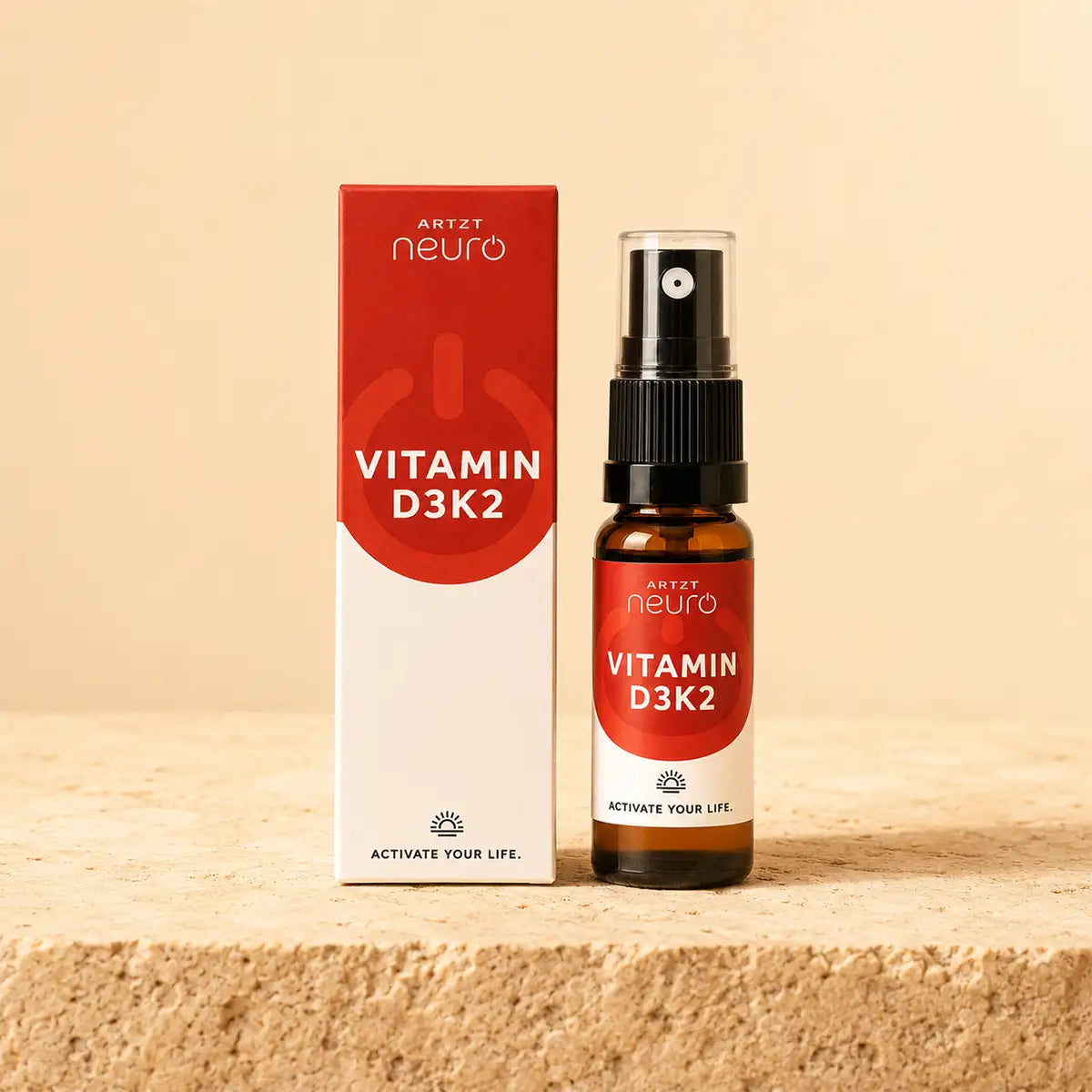
The ratio of D3 to K2 itself is purely a formulation question, not a promise of effect: The ARTZT neuro Vitamin D3K2 Spray provides 50 µg of vitamin D3 and 200 µg of vitamin K2 (MK-7 all-trans) per daily dose, which corresponds to a K2/D3 ratio of 0.1. Many combination products on the market have a ratio of 0.02 to 0.04, which is significantly lower.
Properly Taking Vitamin D and K2: Dosage, Timing, Safety
Both vitamin D and vitamin K2 are fat-soluble, which has two practical consequences: both are best absorbed with a fatty meal, and both are stored in fatty tissue instead of being simply excreted like water-soluble vitamins. So, when you should take vitamin D depends less on the time of day and more on the meal; the exact time of day plays a minor role, regularity is crucial. A spray has a practical advantage over a capsule here: it can be taken directly with a meal without water, making it easier to integrate into an existing routine.
Those starting to take it also don't have to worry about missing the "right" time. Since both vitamin D and K2 build up in the body over weeks, it's not about a single day, but about continuous intake throughout the entire dark season.
Precisely this storage capacity makes vitamin D overdose a legitimate but often exaggerated topic. A 2018 review by Galior, Grebe, and Singh, which evaluates published case reports of vitamin D intoxications, shows that overdoses practically exclusively arise from massive dosing or labeling errors in very high-dose preparations, not from norm-compliant, everyday supplementation.⁷ With a moderately dosed, clearly declared supplement in the low double-digit microgram range, an overdose is therefore less a question of the amount of the individual preparation than of the conscious total intake from all sources.
Those who already supplement other nutrients in a structured way will find increasing evidence in the scientific literature of a possible role of magnesium in vitamin D metabolism: it is discussed as a cofactor for several activation steps.⁹,¹⁰ You can read more about the role of magnesium in the article on iodine deficiency in Germany, which also covers iodine with magnesium.
Vitamin D Throughout the Year: Winter and the Immune System
Vitamin D in winter is a different topic than vitamin D in summer, even if the recommended daily intake doesn't distinguish them. Between March and October, under the conditions described above, the body can cover most of its needs itself, provided one is regularly outdoors.⁴ From October to March, targeted supplementation practically takes on the role that the sun plays in summer.
The connection between vitamin D and the immune system is also scientifically recognized: vitamin D contributes to the normal function of the immune system, a connection also confirmed by the EFSA in its scientific assessment.⁸ Especially in winter, when endogenous synthesis fails anyway and infections occur more frequently, this is an additional argument for actively monitoring the supply throughout the cold season instead of leaving it to chance.
This is also why vitamin D in the ARTZT neuro System is not considered in isolation, but as part of the element of light: daylight controls your biological rhythm and influences far more than just vitamin D production, including energy and sleep. Those who regularly go outdoors during the day in winter, despite short, dark days, address both levels simultaneously: rhythm through daylight itself and nutrient supply through targeted supplementation where the sun alone is not enough.
Conclusion: Sunshine Vitamin Plus K2 as Basic Supply
Vitamin D is not a wrong name, but an incomplete one. Endogenous production at German latitudes is biologically limited for large parts of the year, and even a well-filled vitamin D store only unfolds its effect on calcium metabolism in conjunction with sufficient vitamin K2. For all those who do not want to leave their vitamin D supply to chance, this exact interplay is the starting point: The ARTZT neuro Vitamin D3K2 Spray provides D3 and K2 in a 0.1 ratio, based on the very mechanism described in this article.


As with all elements of the ARTZT neuro system, the same applies here: nutrients never act in isolation. Vitamin D3 and K2 are an example of how two individual building blocks only combine to form a meaningful basic supply when working together, embedded in sufficient daylight, exercise, and regeneration.
Briefly Explained: The Most Important Questions About Vitamin D and K2
How much sun do you need daily for enough vitamin D?
The Federal Institute for Risk Assessment recommends exposing about a quarter of the uncovered body surface—face, hands, and parts of arms and legs—to the sun for 5 to 25 minutes several times a week, depending on skin type. This recommendation applies only for about half of the year: from October to March, UVB radiation in Germany is not sufficient for this.⁴,²
What are the symptoms of vitamin D deficiency?
Typical but non-specific signs include persistent fatigue, reduced resilience, muscle weakness, and increased susceptibility to infections. Since these symptoms can have many possible causes, a deficiency can only be reliably determined by measuring the 25(OH)D level in the blood, not by self-assessment alone.¹
Why is vitamin D3 not enough without K2?
Vitamin D increases calcium absorption from food, but it does not control where this calcium is directed in the body. This control is taken over by vitamin K2, which activates calcium-binding proteins and is thus involved in calcium metabolism. Higher K2 intake has been associated with less vascular calcification in cohort studies.⁶
Can you take too much vitamin D?
In principle, yes, but in practice almost exclusively due to massive dosing or labeling errors with very high-dose preparations. An evaluation of published case reports on vitamin D overdose shows that intoxications practically do not occur with moderately dosed, norm-compliant preparations.⁷
When should you take vitamin D?
Since vitamin D is fat-soluble, it is best absorbed with a fatty meal. The exact time of day plays a minor role; regular daily intake is crucial.
References
- Rabenberg, M., Scheidt-Nave, C., Busch, M. A., Rieckmann, N., Hintzpeter, B. & Mensink, G. B. M. (2015). Vitamin D status among adults in Germany – results from the German Health Interview and Examination Survey for Adults (DEGS1). BMC Public Health, 15, 641. DOI: 10.1186/s12889-015-2016-7
URL: https://bmcpublichealth.biomedcentral.com/articles/10.1186/s12889-015-2016-7
- Webb, A. R., Kline, L. & Holick, M. F. (1988). Influence of Season and Latitude on the Cutaneous Synthesis of Vitamin D3. The Journal of Clinical Endocrinology & Metabolism, 67(2), 373–378. DOI: 10.1210/jcem-67-2-373
URL: https://pubmed.ncbi.nlm.nih.gov/2839537/
- Deutsche Gesellschaft für Ernährung (DGE). FAQ Vitamin D.
URL: https://www.dge.de/gesunde-ernaehrung/faq/vitamin-d/
- Bundesinstitut für Risikobewertung (BfR). Vitamin D – Sonne und Bewegung fördern eine gute Versorgung.
URL: https://www.bfr.bund.de/veroeffentlichung/ausgewaehlte-fragen-und-antworten-zu-vitamin-d/
- Schurgers, L. J., Teunissen, K. J., Hamulyák, K., Knapen, M. H., Vik, H. & Vermeer, C. (2007). Vitamin K-containing dietary supplements: comparison of synthetic vitamin K1 and natto-derived menaquinone-7. Blood, 109(8), 3279–3283. DOI: 10.1182/blood-2006-08-040709
URL: https://pubmed.ncbi.nlm.nih.gov/17158229/
- Geleijnse, J. M., Vermeer, C., Grobbee, D. E., Schurgers, L. J., Knapen, M. H. J., van der Meer, I. M., Hofman, A. & Witteman, J. C. M. (2004). Dietary Intake of Menaquinone Is Associated with a Reduced Risk of Coronary Heart Disease: The Rotterdam Study. The Journal of Nutrition, 134(11), 3100–3105. DOI: 10.1093/jn/134.11.3100
URL: https://pubmed.ncbi.nlm.nih.gov/15514282/
- Galior, K., Grebe, S. & Singh, R. (2018). Development of Vitamin D Toxicity from Overcorrection of Vitamin D Deficiency: A Review of Case Reports. Nutrients, 10(8), 953. DOI: 10.3390/nu10080953 · URL: https://pubmed.ncbi.nlm.nih.gov/30042334/
- EFSA NDA Panel (2015). Scientific Opinion on the substantiation of a health claim related to vitamin D and contribution to the normal function of the immune system. EFSA Journal, 13(6), 4182. DOI: 10.2903/j.efsa.2015.4182
URL: https://www.efsa.europa.eu/en/efsajournal/pub/4182
- Dai, Q., Zhu, X., Manson, J. E. et al. (2018). Magnesium status and supplementation influence vitamin D status and metabolism: results from a randomized trial. The American Journal of Clinical Nutrition, 108(6), 1249–1258. DOI: 10.1093/ajcn/nqy274
URL: https://pubmed.ncbi.nlm.nih.gov/30541089/ - Uwitonze, A. M. & Razzaque, M. S. (2018). Role of Magnesium in Vitamin D Activation and Function. The Journal of the American Osteopathic Association, 118(3), 181–189. DOI: 10.7556/jaoa.2018.037
URL: https://pubmed.ncbi.nlm.nih.gov/29480918/ - Leal, A. C. G. B., Corrêa, M. P., Holick, M. F., Melo, E. V. & Lazaretti-Castro, M. (2021). Sun-induced production of vitamin D3 throughout 1 year in tropical and subtropical regions: relationship with latitude, cloudiness, UV-B exposure and solar zenith angle. Photochemical & Photobiological Sciences, 20(2), 265–274. DOI: 10.1007/s43630-021-00015-z
URL: https://pubmed.ncbi.nlm.nih.gov/33721248/
Transparency note: This article was created with the help of AI and subsequently edited.