



















Reading time: 8 minutes
Many people in Germany reach for iodized salt – often without knowing how good their iodine supply actually is. A look at the current data shows: The nutritional gap of iodine deficiency is often larger than assumed.
Current data from the iodine monitoring of the Robert Koch Institute paint a clear picture: Approximately 32 percent of adults and 44 percent of children and adolescents in Germany consume less iodine than they actually need.¹ The World Health Organization thus once again classifies Germany as an area with mild iodine deficiency. This condition was actually believed to have been overcome in this country. Many therefore resort to iodine tablets. However, before a dietary supplement makes sense, a closer look is worthwhile: Why has the deficiency returned, and what role does iodine actually play in the body?
Contents
- What iodine really controls in the body
- Iodine deficiency: The numbers that make you sit up and take notice
- Why iodized salt alone is no longer enough
- Iodine deficiency: Who is particularly affected
- Recognizing iodine deficiency: Symptoms and diagnosis
- How much iodine per day is really useful?
- Iodine from diet: Where the limits lie
- Iodine and magnesium: the combination in the ARTZT neuro System
- Conclusion
What iodine really controls in the body
Iodine and the thyroid gland are inextricably linked: Iodine itself has no direct effect. Its importance only arises through a single organ, the thyroid gland. It uses iodine as a building block for the hormones T3 (triiodothyronine) and T4 (thyroxine), which are among the most far-reaching messenger substances in the body. Almost every cell has receptors for thyroid hormones, which means they influence energy metabolism, heat production, growth, and the development of the nervous system.²
The Swiss nutritionist Michael B. Zimmermann comprehensively described this connection in his much-cited review article in Endocrine Reviews: Depending on the severity and life stage, iodine deficiency affects a whole spectrum of functions, from thyroid function itself to cognitive performance.² These are precisely the connections that also underpin the EU-approved claims about iodine:
- Iodine contributes to normal production of thyroid hormones and normal thyroid function.
- Iodine contributes to normal energy metabolism.
- Iodine contributes to normal cognitive function.
- Iodine contributes to normal functioning of the nervous system.
- Iodine contributes to the maintenance of normal skin.
These statements sound cautious. That's precisely the point: it's not about enhancing performance, but about the foundation on which energy, concentration, and metabolism can function at all.
Iodine deficiency: The numbers that make you sit up and take notice
How poor iodine supply actually is in Germany is most clearly shown in urinary iodine excretion, the most reliable marker for a population's iodine intake. According to WHO criteria, a population is considered sufficiently supplied only with a median value of 100 µg/l.

For adults, this value in the DEGS study by the Robert Koch Institute was only 69 µg/l for men and 54 µg/l for women, significantly below the WHO target value.¹ Converted, this corresponds to an estimated daily iodine intake of around 125 to 126 µg, noticeably less than the current reference value for adults.
The trend is even clearer among children and adolescents: while the median iodine excretion in the KiGGS baseline survey (2003–2006) was still around 118 µg/l, it had fallen to about 89 µg/l in KiGGS Wave 2 (2014–2017), a decrease of 13 percent within eleven years.¹ For comparison: the original KiGGS survey itself had already shown that about 40 percent of children were below the WHO target range of 100 µg/l. The supply situation has therefore not improved since then, but has worsened.³
This development is remarkable because Germany was considered a success story in the 1980s and 1990s: the voluntary iodization of table salt significantly improved the supply, and visible deficiency symptoms such as the classic goiter became less common.⁴ The fact that the values are now falling again has concrete, understandable causes.
Why iodized salt alone is no longer enough
German iodine prophylaxis is still primarily based on a voluntary measure: the enrichment of table salt with iodine. The problem is that this voluntariness has noticeably decreased in recent years. The causes of the renewed iodine deficiency are therefore less due to biology than to changed eating and consumption habits.
According to the Max Rubner Institute, only about 10 percent of bread and baked goods manufacturers currently use iodized salt, although bread and baked goods are traditionally among the most important iodine sources in the everyday diet.⁵ The proportion of iodized salt in processed foods such as ready-made soups has also been declining since 2016.⁵ In addition, there are several parallel trends:
- Fast food and catering establishments often do not use iodized salt.
- Consciously "healthy" salt alternatives such as coarse sea salt, Fleur de Sel, or Himalayan salt usually do not contain added iodine. Especially among health-conscious people, this can contribute to an undersupply.
- Salt-reduced diets, often recommended for cardiovascular reasons, automatically also reduce iodine intake through salt.
- Plant-based diets forgo dairy products and seafood, two of the most important natural iodine sources.
None of these developments are wrong in themselves. However, together they explain why a supply strategy from the 1980s can no longer keep pace with today's dietary reality.
Iodine deficiency: Who is particularly affected
Not everyone carries the same risk. Particularly at risk are:
Pregnant and breastfeeding women. Iodine requirements increase significantly during this phase because the thyroid gland and central nervous system develop in the unborn child. This process relies on sufficient maternal iodine. The DGE recommends 220 µg of iodine per day for pregnant women and 230 µg for breastfeeding women, compared to 150 µg for other adults.⁶ Iodine is therefore a nutrient that needs to be actively monitored, especially during breastfeeding.
Vegans and vegetarians. Those who forgo fish and dairy products lose two of the most reliable sources of iodine in their daily diet. Unlike cow's milk, plant-based milk alternatives in Germany are generally not fortified with iodine, which further increases the risk.⁶ For vegans, iodine is therefore a topic that should be actively considered in meal planning.
Children and adolescents. Due to growth and development, they react particularly sensitively to an inadequate supply, which is reflected in the current KiGGS figures (44 percent undersupplied).¹
Recognizing iodine deficiency: Symptoms and diagnosis
A mild to moderate iodine deficiency is usually inconspicuous. That's precisely what makes it insidious. Possible signs of an insufficient iodine supply include persistent fatigue, increased sensitivity to cold, difficulty concentrating, dry skin, or weight gain despite a consistent diet. In cases of pronounced, long-lasting deficiency, a goiter (enlarged thyroid gland) can also develop.⁴
However, these symptoms have many possible causes and are not a reliable substitute for a genuine iodine deficiency test. Anyone who suspects an iodine deficiency should have it clarified by a doctor, for example, by determining the TSH value in the blood or measuring iodine excretion in the urine. Self-diagnosis based on symptom lists does not replace this diagnosis.
How much iodine per day is really useful?
The German Nutrition Society (DGE) revised its reference values for iodine in 2025. The new value for adolescents and adults is 150 µg per day, lower than the previous value of 200 µg (under 51 years) or 180 µg (over 51 years).⁷ This does not mean that iodine has suddenly become less important: the previous values contained a conscious safety margin to compensate for the already insufficient population supply. This margin no longer corresponds to current scientific methodology, which is why the DGE now states the actual average requirement.⁷
| Group | Reference value iodine/day |
|---|---|
| Infants (0 - 12 months) | 80 µg |
| Children (1 - 7 years) | 90 µg |
| Children (7 - 13 years) | 120 µg |
| Adolescents & Adults (from 13 years) | 150 µg |
| Pregnant women | 220 µg |
| Breastfeeding women | 230 µg |
Source: DGE, Reference values 2025.⁶
And how much is too much? According to the EFSA's assessment, the total intake considered safe ("Tolerable Upper Intake Level") for adults is around 600 µg per day. This is significantly above the requirement, but this value can certainly be reached with uncontrolled supplementation.⁶ Permanent iodine overdose can unbalance thyroid function in both directions and is associated with an increased risk of autoimmune thyroid diseases.⁶ Particular caution is advised with dried seaweeds: The Federal Institute for Risk Assessment explicitly warns against brown algae products with very high, uncontrolled iodine content.⁸ Those supplementing with iodine should therefore pay attention to a moderate, clearly declared dosage instead of the highest possible amounts.
Iodine from diet: Where the limits lie
The highest natural iodine amounts are provided by seafood: 120 g of cod contain around 330 µg of iodine, 120 g of pollock about 94 µg.⁶ Dairy products also contribute significantly: A glass of milk (250 ml) provides around 30 µg, 100 g of mozzarella about 100 µg. However, the content varies depending on the animals' feed.⁶ Iodized table salt provides about 40 µg with typical household use (around 2 g per serving).⁶
For people who regularly eat seafood and dairy products and consistently use iodized salt, the requirement can largely be met through iodine-containing foods. For everyone else, whether for taste, ethical, or dietary reasons, there often remains a gap that is difficult to close solely through food choices. This is precisely where targeted, moderately dosed iodine supplementation can be beneficial.
Iodine and magnesium: the combination in the ARTZT neuro System
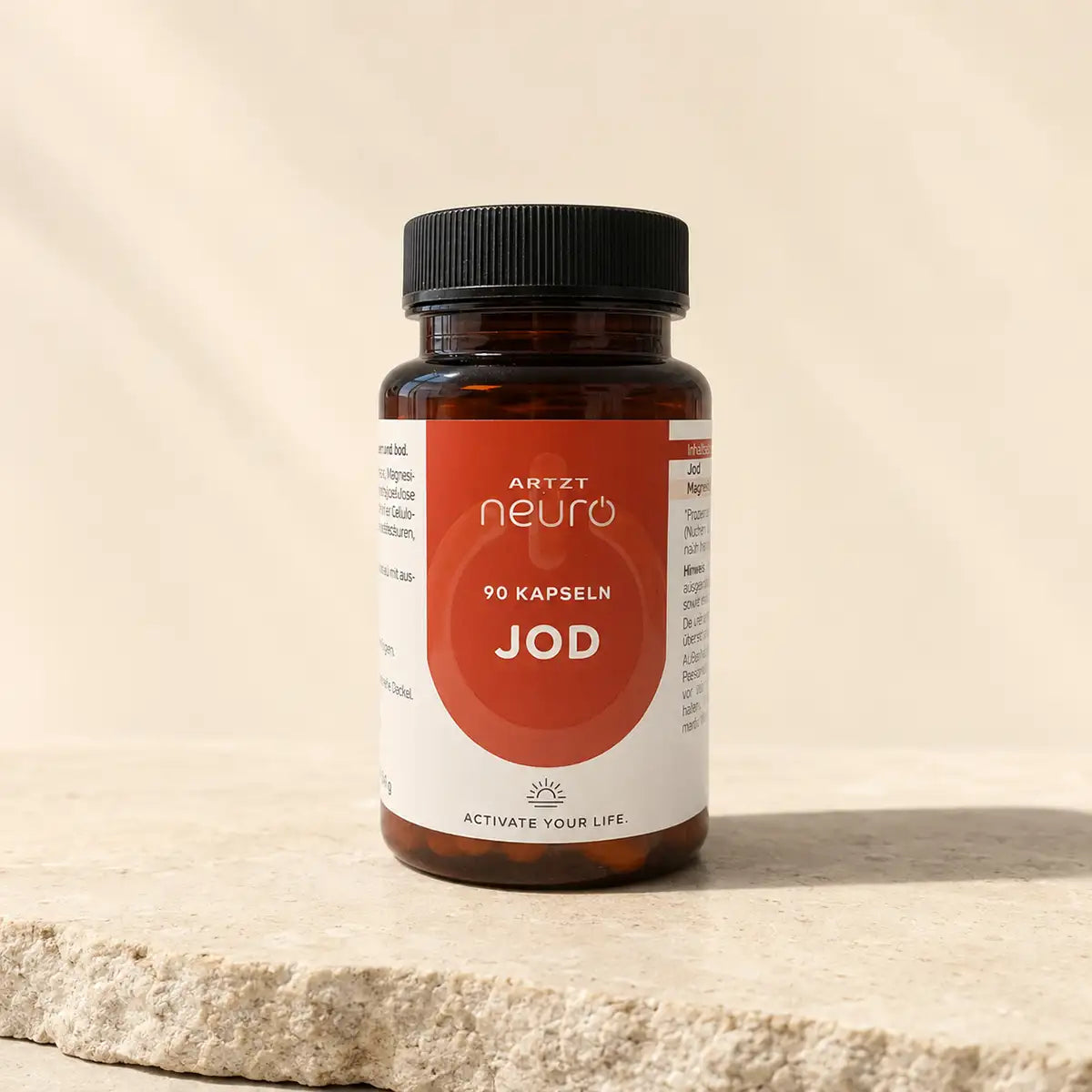
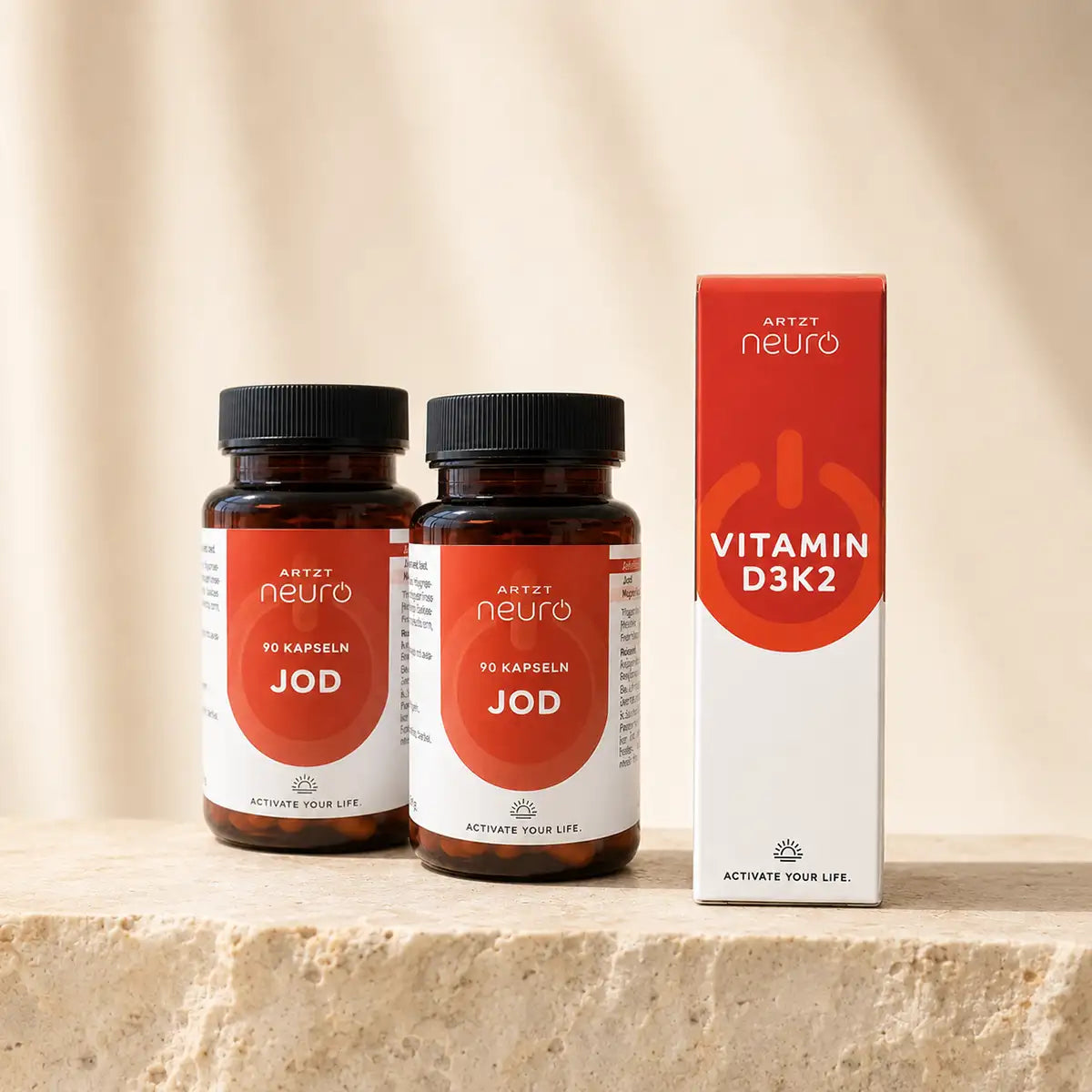
ARTZT neuro never views nutrient supply as an isolated measure, but as part of a larger system consisting of movement, light, regeneration, and targeted nutrient intake. For the basic supply of iodine, we therefore rely on Iodine with Magnesium: one capsule daily provides 200 µg of iodine, based on daily requirements, combined with 57 mg of well-tolerated magnesium bisglycinate.
The combination is no coincidence: several claims approved for magnesium also apply here:
- Magnesium contributes to normal energy metabolism.
- Magnesium contributes to normal functioning of the nervous system.
- Magnesium contributes to normal muscle function.
Both micronutrients thus act on related systems without replacing each other.
Another reason we chose magnesium as a companion is that magnesium acts as a cofactor in the conversion of vitamin D into its active form in the body, a connection that is increasingly being discussed in scientific literature.⁹,¹⁰
The dosage is also deliberately chosen: 200 µg of iodine per capsule corresponds to the daily requirement, without quickly leading to an overdose if additional iodine is consumed through food. This makes the combination suitable for long-term, daily intake. It serves as a targeted supplement, not as a substitute for a balanced diet. Those who want to buy iodine tablets should pay attention to such a moderate, clearly declared dosage instead of the highest possible active ingredient quantities.

Conclusion
Iodine deficiency is not a spectacular topic. That's precisely what makes it dangerous. It progresses silently, but according to current data, it affects almost every third adult and almost every second child in Germany.¹ The good news: The solution is just as unspectacular. A conscious look at iodine-containing foods, the use of iodized table salt and, where diet alone is not sufficient, a moderately dosed, targeted supplement are often enough to bring the supply back into balance.
As with all elements of the ARTZT neuro Holistic Health Systems: it's not about the one big solution, but about the small, well-founded building blocks that bring your system back into its natural rhythm.
References
- Federal Ministry of Food, Agriculture and Home Affairs (BMLEH) (2025). Iodine supply in Germany: Results of iodine monitoring in children, adolescents and adults.
URL: https://www.bmleh.de/DE/themen/ernaehrung/gesunde-ernaehrung/degs-jod-studie.html - Zimmermann, M. B. (2009). Iodine Deficiency. Endocrine Reviews, 30(4), 376–408. DOI: 10.1210/er.2009-0011
URL: https://pubmed.ncbi.nlm.nih.gov/19460960/ - Thamm, M., Ellert, U., Thierfelder, W., Liesenkötter, K.-P. & Völzke, H. (2007). Iodine supply in Germany. Results of iodine monitoring in the Children and Youth Health Survey (KiGGS). Bundesgesundheitsblatt – Gesundheitsforschung – Gesundheitsschutz, 50(5/6), 744–749. DOI: 10.1007/s00103-007-0236-4
URL: https://link.springer.com/article/10.1007/s00103-007-0236-4 - Robert Koch Institute (RKI). Iodine supply (Health Influencing Factors A–Z topic page).
URL: https://www.rki.de/DE/Themen/Gesundheit-und-Gesellschaft/Gesundheitliche-Einflussfaktoren-A-Z/J/Jodversorgung/jodversorgung-node.html - Max Rubner Institute (MRI). Iodine (Topic page). Federal Research Institute for Nutrition and Food.
URL: https://www.mri.bund.de/de/themen/jod/ - German Nutrition Society (DGE). FAQ Iodine.
URL: https://www.dge.de/gesunde-ernaehrung/faq/jod/ - German Nutrition Society (DGE) (2025). New reference values for iodine intake – Iodine more important than ever! Press release.
URL: https://www.dge.de/presse/meldungen/2025/neue-referenzwerte-fuer-die-jodzufuhr/ - Bundesinstitut für Risikobewertung (BfR) (2025). Aktualisierung der Höchstmengenvorschläge für Jod in Lebensmitteln inklusive Nahrungsergänzungsmitteln. Stellungnahme Nr. 065/2025.
URL: https://www.bfr.bund.de/assets/01_Ver%C3%B6ffentlichungen/Stellungnahmen_deutsch/aktualisierung-2025-h%C3%B6chstmengenvorschl%C3%A4ge-f%C3%BCr-jod-in-lebensmitteln-inklusive-nahrungserg%C3%A4nzungsmitteln.pdf - Dai, Q., Zhu, X., Manson, J. E., Song, Y., Li, X., Franke, A. A., Costello, R. B., Rosanoff, A., Nian, H., Fan, L., Murff, H., Ness, R. M., Seidner, D. L., Yu, C. & Shrubsole, M. J. (2018). Magnesium status and supplementation influence vitamin D status and metabolism: results from a randomized trial. The American Journal of Clinical Nutrition, 108(6), 1249–1258. DOI: 10.1093/ajcn/nqy274
URL: https://pubmed.ncbi.nlm.nih.gov/30541089/ - Uwitonze, A. M. & Razzaque, M. S. (2018). Role of Magnesium in Vitamin D Activation and Function. The Journal of the American Osteopathic Association, 118(3), 181–189. DOI: 10.7556/jaoa.2018.037
URL: https://pubmed.ncbi.nlm.nih.gov/29480918/
Transparency note: This article was created with the help of AI and subsequently edited.